
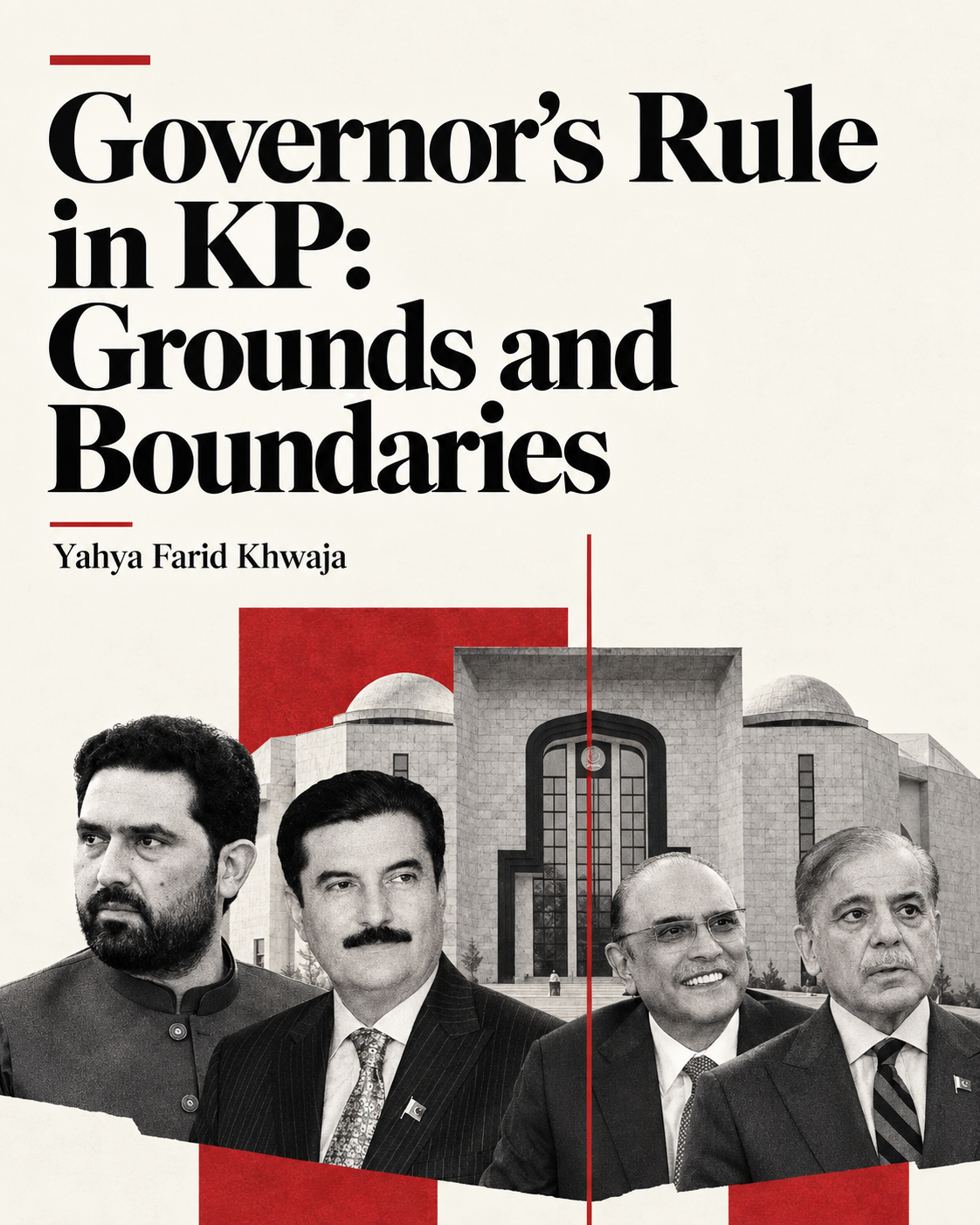
Yahya Farid Khwaja
The writer is a Lawyer based in Islamabad
Plans for talks between PTI and the federal government appear to have eased, for now, the immediate risk of an emergency or governor’s rule in Khyber Pakhtunkhwa. Neither option, however, has been ruled out. Such interventions have precedents, and courts have upheld them subject to constitutional limits, as in the 1994 Pir Sabir Shah case concerning the then NWFP. The renewed debate therefore warrants scrutiny: what developments have prompted the Centre to consider these exceptional measures, and do they establish a constitutional basis for intervention in an elected provincial government?
Article 232 permits the President to proclaim an emergency where war, external aggression or internal disturbance beyond provincial control creates a grave threat to the security of Pakistan or any part of it. For internal disturbance, theConstitution requires a Provincial Assembly resolution, while providing that a proclamation issued without it must receive approval from each ParliamentaryHouse (National Assembly and Senate) within ten days. An emergency underArticle 232 expands Federal legislative and executive authority, including powers to direct or assume provincial executive functions, but does not automatically remove the provincial government.
Article 234, commonly associated with Governor’s rule, applies where provincial government cannot be carried on in accordance with the Constitution. On receiving a Governor’s report and being satisfied that this condition exists, the President may assume provincial executive functions or direct the governor to exercise them on his behalf, and place provincial legislative powers under Parliament’s authority.The proclamation expires after two months unless approved by a joint sitting, with extensions subject to an overall six-month limit. Its defining condition is failure of constitutional machinery, which must be established beyond merely alleging political disagreement or poor governance.
The most directly relevant precedent for KPK is the proclamation of February 25, 1994, placing the then North West Frontier Province under governor’s rule. In Pir Sabir Shah v Federation of Pakistan (PLD 1994 SC 738), the Supreme Court upheld the temporary assumption of provincial functions but, by a seven-to-two majority, held that the President could not remove the chief minister and cabinet beyond the proclamation’s duration. The judgment recognised temporary intervention while rejecting permanent dismissal through that instrument. Other provinces have experienced similar interventions in different circumstances. Governor’s rule was imposed in Sindh in 1998 amid political conflict and violence in Karachi. In Punjab, it followed the Sharif brothers’ disqualification in February 2009 and was lifted the following month.
Balochistan provides a more recent security-related example. On January 14, 2013, governor’s rule was imposed following the Quetta bombings and protests by the Hazara community, displacing Nawab Aslam Raisani’s administration and placing executive authority with Governor Nawab Zulfikar Ali Magsi. Raisani’s government stood restored when the two-month period expired in March. The episode illustrates the temporary character of intervention under Article 234, although its circumstances cannot automatically justify a similar measure in KP.
The Centre has cited deteriorating security and alleged governance failures in KP as reasons for considering governor’s rule or an emergency. Federal ministers accuse the provincial administration of inadequately supporting counterterrorism efforts and failing to provide sufficient personnel, equipment and resources to theCounter-Terrorism Department. Their argument is that the provincial leadership has neglected its responsibility to protect citizens and support law enforcement. These allegations, however, would need to be supported by evidence connecting particular administrative failures to the constitutional grounds for intervention.
The planned march onIslamabad has added a political dimension to the confrontation. Rana Sanaullahh as portrayed it as a provincial government acting against the capital, questioning whether an elected administration can use its position to support such mobilisation. KP disputes the Centre’s allegations, attributes continuing in security to a flawed counterterrorism policy and maintains that its protest would be peaceful. The legal assessment must therefore distinguish the exercise of political rights from any demonstrable unlawful use of provincial authority or public resources. The announcement of a march alone cannot settle that question.
These competing claims must be assessed against the distinct constitutional thresholds. For an emergency based on internal disturbance, Article 232 requires a grave threat to security beyond the provincial government’s capacity to control. Article 234 requires circumstances in which provincial government cannot continue in accordance with the Constitution. Allegations of poor governance, policy disagreement or political protest do not, by themselves, establish either condition. The Centre would need to explain how the evidence satisfies the provision it invokes, while KP could counter with a record showing that its institutions remain functional and capable of discharging their constitutional responsibilities.
Any legal challenge would first face Article 236(2), which expressly bars courts from questioning proclamations and orders under the Constitution’s emergency provisions.Nevertheless, Pir Sabir Shah recognises scope for scrutinising action taken without jurisdiction, beyond constitutional authority or in bad faith. KP could argue that the stated reasons do not meet the relevant threshold, that mandatory procedures were disregarded, or that the power was exercised for an ulterior political purpose. Such arguments would require specific particulars and supporting evidence. Their success would depend on establishing a legally reviewable defect, rather than merely disputing the Centre’s political assessment.
The establishment of the Federal Constitutional Court (FCC) has changed the forum for challenging governor’s rule, while leaving Article 236(2)’s restriction on judicial review intact. A dispute between the KP government and the Federation would fall within the FCC’s exclusive jurisdiction under Article 175E(1), with relief limited to a declaratory judgment under Article 175E(2). However, amended Article 189means that earlier Supreme Court decisions, including Pir Sabir Shah and Farooq Leghari, do not bind the FCC. KP could rely on their recognition of review for lack or excess of jurisdiction and bad faith, but theFCC would ultimately determine the scope of those exceptions under the present constitutional framework.